Reading Chekhov by Janet Malcolm
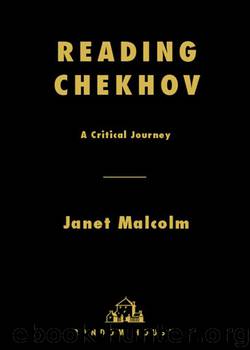
Author:Janet Malcolm
Language: eng
Format: epub
Tags: Fiction
ISBN: 9780307431660
Publisher: Random House Publishing Group
Published: 2007-12-18T05:00:00+00:00
Eight
Driving back to Yalta from Oreanda, I suggest to Nina, sitting beside me in the rear seat—as I had suggested to Sonia in Moscow—that she buckle her seat belt. Sonia’s response had been to inform me icily that only people in front were required to use seat belts. (Vladimir drove without one, buckling up only when he was about to pass a police checkpoint.) I asked Sonia if she thought the rear seat belts were there for decoration. She looked at my strapped-in middle contemptuously. “It is not necessary for you to do that,” she said. The ever-agreeable Nina, however, puts on her seat belt, like a good child consenting to try a new food. She translates my von Korenesque lecture on the foolhardiness of driving without a seat belt to the unbelted Yevgeny, who laughs heartily and tells the following anecdote, which he says came from a doctor at a sanitarium where he once worked: “When there is an automobile accident, the person who wasn’t wearing a seat belt is found with a leg here, an arm there, the head there. The person who was wearing a seat belt is found in his seat completely intact—and dead.”
Illustrations like this of resistance to advances in knowledge appear throughout Chekhov’s stories and letters. In a letter to his family written during his journey to Sakhalin (May 1890), he comments on the primitive state of medicine in a village near Tomsk. “Bleeding and cupping are done on a grandiose, brutal scale. I examined a Jew with cancer in the liver. The Jew was exhausted, hardly breathing, but that did not prevent the feldsher from cupping him twelve times.” This terrible scene is reprised in the death of Nikolai Tchikildyeev, in “Peasants” (1897). (Chekhov has him cupped twelve times, like the Jew—and then, as if to quantify the difference between life and art, twelve times again.) In the reluctant autobiographical note that Chekhov composed for his medical-school reunion, he spoke of the impact of his medical education on his writing:
It significantly broadened the scope of my observations and enriched me with knowledge whose value for me as a writer only a doctor can appreciate. It also served as guiding influence; my intimacy with medicine probably helped me to avoid many mistakes. My familiarity with the natural sciences and the scientific method has always kept me on my guard; I have tried wherever possible to take scientific data into account, and where it has not been possible I have preferred not writing at all. . . . I am not one of those writers who negate the value of science, and I would not wish to be one of those who believe they can figure out everything for themselves.
Note the many negatives: Chekhov’s acknowledgment of the “broadened scope” and “enrichment” the study of medicine has given him is perfunctory, compared to his gratitude for what it has helped him to avoid. As in his letter to Shcheglov about the limits of psychological understanding (“Nothing is clear in this world.
Download
This site does not store any files on its server. We only index and link to content provided by other sites. Please contact the content providers to delete copyright contents if any and email us, we'll remove relevant links or contents immediately.
4 3 2 1: A Novel by Paul Auster(12382)
The handmaid's tale by Margaret Atwood(7762)
Giovanni's Room by James Baldwin(7334)
Big Magic: Creative Living Beyond Fear by Elizabeth Gilbert(5768)
Asking the Right Questions: A Guide to Critical Thinking by M. Neil Browne & Stuart M. Keeley(5766)
Ego Is the Enemy by Ryan Holiday(5425)
The Body: A Guide for Occupants by Bill Bryson(5087)
On Writing A Memoir of the Craft by Stephen King(4938)
Ken Follett - World without end by Ken Follett(4726)
Adulting by Kelly Williams Brown(4569)
Bluets by Maggie Nelson(4550)
Eat That Frog! by Brian Tracy(4528)
Guilty Pleasures by Laurell K Hamilton(4443)
The Poetry of Pablo Neruda by Pablo Neruda(4100)
Alive: The Story of the Andes Survivors by Piers Paul Read(4026)
White Noise - A Novel by Don DeLillo(4006)
Fingerprints of the Gods by Graham Hancock(4000)
The Book of Joy by Dalai Lama(3979)
The Bookshop by Penelope Fitzgerald(3848)
